Buda TX Cleanout Site: Core Web Vitals Case Study
On a Buda, TX hoarding cleanout website I took mobile LCP from the 4-5 second range to under 2 seconds, replaced a heavy third-party estimate form with a light native one, and reserved layout space so the page stopped shifting. Lead-notification emails then arrived on most days rather than sporadically - an inbox observation, not a measured conversion rate, and the local SEO work shipped alongside the performance work so the two cannot be separated.
A homeowner searching for hoarding cleanout help on a phone is not browsing. They have made a decision, they want a number, and they will take it from whichever site loads and lets them ask.
That is the whole reason I looked at this operator’s Core Web Vitals before touching anything else. This is a Buda, TX cleanout business serving the southern edge of the Austin metro, and its traffic was overwhelmingly mobile and overwhelmingly high-intent. A slow estimate page in that context is not a technical nit. It is a lost job, handed to the next result.
The starting problem
The site ranked well enough to get seen. What it did badly was hold on to the person who saw it.
On a mid-range phone over a normal mobile connection, the main content took several seconds to appear, the page jumped around while it settled, and the estimate form - the only thing on the site that mattered commercially - was an embedded widget from a third-party provider that took longer to become usable than the rest of the page took to render.
None of that shows up in a ranking report. It shows up as an inbox that goes quiet.
What the audit found
I ran the key pages through PageSpeed Insights on mobile and cross-checked how Google was actually seeing the site in Search Console, which indexes mobile-first. Three metrics, three separate fixes: LCP INP CLS is the order I worked them in, worst first.
- LCP was landing in the 4-5 second range on mobile. The hero image was a full-size photograph served unresized, and a web font was blocking text from painting.
- INP was poor specifically where it hurt most. The third-party estimate form loaded its own framework, and until it finished, taps did nothing.
- CLS was visible to the naked eye. Images had no declared dimensions, and the map, the review widget and the form all appeared late and pushed everything below them down the page.
The audit did not turn up anything exotic. It turned up the ordinary set of problems that a template site accumulates when nobody has looked at it on a phone.
Fixing LCP: the hero image and the font
The largest element on every important page was the hero photo, so that is where the time was going.
I compressed and resized it to the dimensions it was actually displayed at, converted it to WebP, and preloaded it so the browser stopped discovering it late. Then I self-hosted the web font instead of pulling it from a third party, and set font-display: swap so text painted immediately in a fallback rather than waiting on a download. Last, I stripped the unused CSS and JavaScript the theme was shipping on every page whether or not anything used it.
That combination moved mobile LCP from the 4-5 second range to under 2 seconds in my PageSpeed Insights readings. I did not export a report, which is why that figure is graded on this page as my own before-and-after reading rather than as published data.
Fixing INP: the estimate form is the whole point
For a cleanout business, the estimate request is the conversion. Everything else on the site is context.
So the heaviest thing on the site being the estimate form was the problem worth solving. I removed the embedded third-party form and rebuilt it as a plain native form - short, no framework, wired directly to email and the CRM. It became usable the moment the HTML arrived instead of after a bundle downloaded and hydrated.
Everything that was not the form got pushed later: the chat widget, the tracking pixels and the review widget were all deferred until after the page was interactive. Where my own scripts were doing long blocks of work on the main thread, I broke them into smaller tasks so an incoming tap was never waiting behind them.
Estimate form conversion is not something I can put a number on here - no before/after submission-rate baseline was recorded. What I can say is that the interaction the entire site exists to support stopped being the slowest thing on it.
Fixing CLS: reserving space before anything arrives
Layout shift is the failure that costs a lead without ever being reported as a bug. Someone reaches for the phone number and the page moves under their thumb.
The fixes were unglamorous. Every image got explicit width and height attributes so the browser could reserve its box before the file arrived. The map embed, the review widget and the form each got a container with a fixed reserved height, so late-loading content dropped into a space that was already held for it. And the font loading was set up so that swapping from the fallback to the real face did not reflow the text around it.
The Buda local SEO layer
Speed alone does not put a page in front of someone in Buda. The performance work shipped alongside a local layer, which is exactly why this case study cannot claim one caused the result.
I rewrote title tags and on-page headings around the service-plus-location combinations people actually type - hoarding cleanup Buda TX, hoarding cleanout near me, and the equivalent decluttering phrasings - rather than the generic service names the template shipped with. That is the same local SEO work that any service business in the metro needs, and Buda sits inside the Austin service area covered on my Austin SEO page, so the geographic relevance was already there to reinforce.
Alongside the on-page work I made the business name, address and phone number consistent between the Google Business Profile and the website, because inconsistent details are one of the cheapest local ranking problems to fix and one of the most common. If you want the longer version of that argument, it is in my guide to optimising a Google Business Profile, and the cost side of this kind of engagement is covered in what local SEO actually costs.
Treating core web vitals local SEO work as a single job rather than two is the honest description of what happened here. The faster mobile path to the estimate form and the Buda-specific targeting were shipped together, deliberately, because the goal was leads and not a score.
What changed
The observable change is in the inbox.
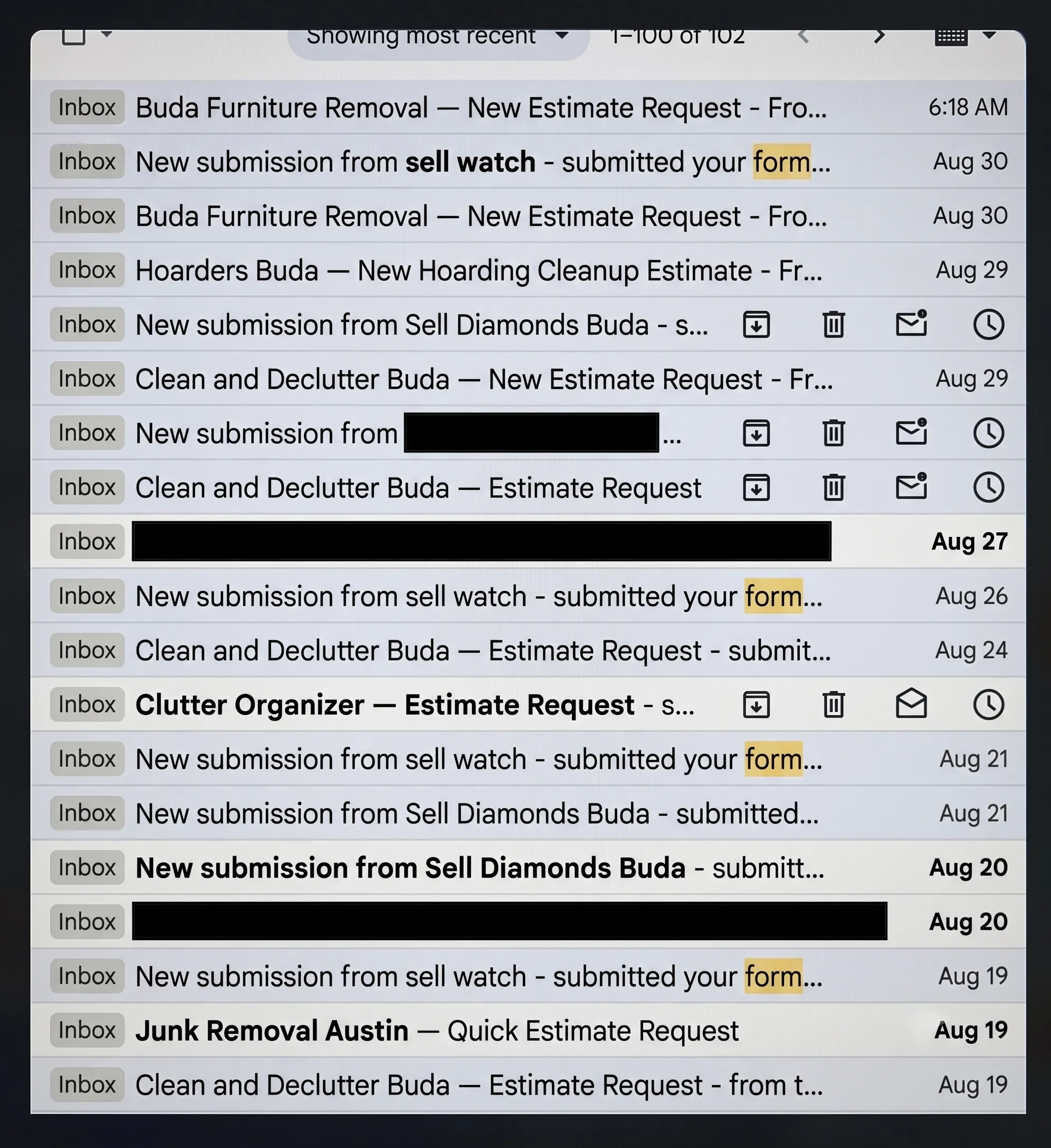
Across 19-30 August 2026, lead-notification emails from the site’s estimate form arrived on most days rather than turning up sporadically. Before the work, notifications were occasional enough that each one was noticeable. After it, they were routine enough that they stopped being.
That is a genuine change in what the owner experiences day to day, and it is also the weakest kind of evidence in this whole write-up. It is a description of a screenshot of an inbox. It is not a conversion rate, not a lead count, and not a comparison against a recorded baseline, because no baseline was recorded. My Austin HVAC Google Business Profile case study is client-reported from a dashboard with no screenshot, and even that is a stronger grade of evidence than this. Read this one accordingly.
Hoarding cleanout SEO has a particular shape that makes the qualitative result at least plausible: search volume is low, intent is extremely high, and the decision window is short. On a site like that, mobile site speed and a form that works on the first tap are not marginal gains. But plausible is not proven, and the section below is the part of this page I would read first.
What this case study does not prove
Five things, stated plainly.
No Core Web Vitals export is published. The LCP figures are my own PageSpeed Insights readings on mobile, taken before and after the work. I did not save a report and there is no Search Console Core Web Vitals extract, so nothing on this page independently confirms them. A reader has my word and nothing else.
There is no before/after lead-count baseline. Nobody recorded how many estimate requests the site produced in the months before the work, so the shift from sporadic to near-daily notifications is an impression formed from watching an inbox, not a measurement. I cannot rule out seasonality, a referral, or ordinary variance.
Per-site attribution is not possible. The inbox in the screenshot receives notifications for several service brands the owner runs, not just this one. Subject lines are not a clean per-site counter, so even the notification cadence cannot be cleanly assigned to this website.
Correlation is not causation. The local SEO layer shipped in the same period as the performance work. Two changes, one uncontrolled observation, no split test - the two cannot be separated, and any claim that the speed work specifically caused the leads would be invented.
Lead notifications are not booked revenue. An estimate request is somebody asking a question. How many of these became quoted jobs, how many of those were won, and what they were worth is information I do not have, and I am not going to imply otherwise.
Frequently asked questions
Why is there no PageSpeed or Search Console screenshot?
Because none was exported at the time. I read the scores in PageSpeed Insights before and after the work and wrote the numbers down, but I did not save a report, so there is nothing to reproduce here. That is why the LCP figures are presented as my own readings rather than as verified measurements.
Did the site's lead volume actually increase?
I cannot prove that it did. No before/after lead-count baseline was recorded, so the only thing the evidence supports is that lead-notification emails arrived on most days across an eleven-day window in August 2026. Whether that is higher than the previous month is an impression formed from watching the inbox, not a measurement.
Was it the performance work or the local SEO work that made the difference?
There is no way to tell from this engagement. The faster pages and the Buda-focused title tags, headings and profile consistency all shipped in the same period, so the two changes are entangled. Anyone claiming to have isolated one of them on a single site with no split test is guessing.
Do the Core Web Vitals figures apply to every page on the site?
No. My readings were taken on the pages that matter for high-intent cleanout searches - the homepage and the main service and estimate pages. Other pages on the site were not individually audited, and PageSpeed Insights results vary between runs on the same URL anyway.
Can the same fixes work on my cleanout or junk-hauling site?
The specific wins here came from a slow hero image, a heavy embedded third-party form and unreserved layout space, which are common but not universal problems. If your site is already lightweight, fixing performance will not move anything and the constraint is somewhere else. I would rather look at your actual pages than promise the same outcome.