HVAC SEO Case Study: 3× Clicks in Three Months
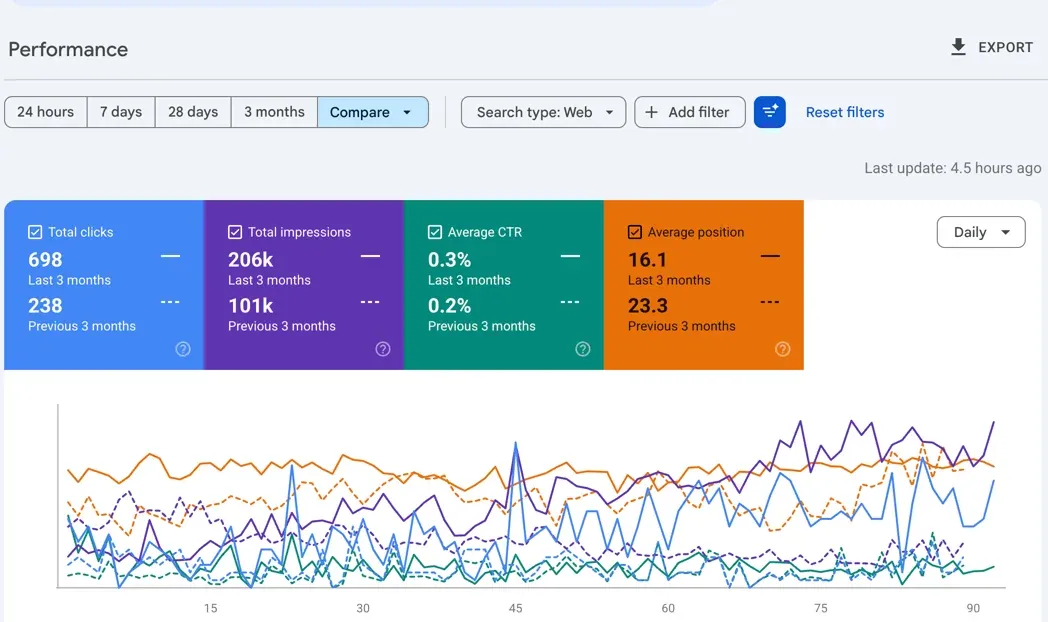
An HVAC contractor went from 238 to 698 Google Search Console clicks in three months — a 193% increase — after I fixed a website that was targeting cities across multiple states, rebuilt a neglected Google Business Profile, and published content on a hub-and-spoke structure. Impressions doubled and average position improved from 23.3 to 16.1.
I picked up this client through a Facebook group in May 2026. They ran an HVAC business with a website that looked fine and performed badly, and a Google Business Profile that had been left alone for the better part of a year.
Three months later, Search Console clicks had roughly tripled. Here is what was actually wrong and what I did about it.
What I inherited
The website was targeting several states at once. This was the significant one. The homepage tried to rank for multiple states, and there were location pages for cities scattered across those states. Google had no clear signal about where this business actually operated, so it ranked weakly everywhere instead of strongly somewhere.
The rest followed from that:
- Service pages were poorly structured — no clear hierarchy, overlapping topics
- Location pages were thin or templated — the kind that differ only by a swapped city name
- The backlink profile was very weak
On the Google Business Profile side:
- Ranking around positions 3-4 in the map pack
- No citations at all
- No reviews in the past year
- No posts in the previous three months
None of that is unusual. It is close to the default state of a local business that has never had anyone owning this work.
Month one — fix the structure
Everything else is wasted effort while the site is telling Google it operates in five states.
I rebuilt the homepage to target a single state, and removed the location pages for cities outside it. That sounds destructive, and deleting pages always feels wrong, but ranking weakly across five states is worth less than ranking strongly in one.
Then:
- 10 citations built through BrightLocal, to establish basic NAP consistency
- Homepage and service page content rewritten and properly optimised
- Four blog posts published on a hub-and-spoke structure
The intention was narrow and deliberate: build genuine authority in one state first.
Month two — the Google Business Profile
With the site no longer working against itself, I moved to the profile.
I audited it and found the primary category was wrong — which is the single most consequential field on a GBP, because it determines which searches you are eligible for at all. Fixing that alone changes what a profile can rank for.
Then:
- Keyword research for the services section, which most profiles leave empty or generic
- Rebuilt the GBP services to match
- 10 more citations
- Asked the client to start collecting reviews — after a year of none
- Five or six GBP posts, built from the service pages rather than invented separately
- Social posts on Facebook
- One guest post link, which measurably helped site authority
Month three — location pages, done properly
Only now did I go back to location pages, organised as a county-and-city structure rather than a flat list. County pages give the city pages something to sit under, and the hierarchy is legible to both a reader and a crawler.
By this point city-page rankings were already improving and the business was generating leads, so the work was expanding something that was demonstrably working rather than guessing.
I built out 10+ location pages while keeping the rest running: reviews, GBP posts, blog posts, social.
The results
| Metric | Before | After | Change |
|---|---|---|---|
| Clicks | 238 | 698 | +193% |
| Impressions | 101k | 206k | +104% |
| Average position | 23.3 | 16.1 | 7.2 positions |
| Average CTR | 0.2% | 0.3% | +50% |
Three months versus the previous three, from Google Search Console.
In the map pack, the business moved from positions 3-4 to positions 1-2 across most of the grid within roughly an 18km radius.
What actually drove it — honestly
About 40% of the traffic increase came from the blog posts. That surprised me slightly, and it is worth saying plainly because most agencies would quietly attribute everything to whatever they most want to sell. The rest came from the service and location pages.
The structural fix in month one does not show up as its own line in any report, but nothing else would have worked without it. Removing pages was the highest-leverage thing I did, and it is the change most clients would push back on.
What this case study does not prove
- The starting point was unusually fixable. A site actively working against itself has a lot of easy upside. A business already structured correctly would not see this kind of movement in three months.
- 0.3% CTR is low in absolute terms. A large volume of impressions on broad, loosely-relevant queries drags it down. The meaningful signal is that CTR rose while impressions doubled.
- Three months is early. Local SEO compounds; it is also reversible if the reviews and posts stop.
- One client is not a pattern. This is the first case study I have published. I would rather show one real result with the caveats attached than five without them.
Where it went next
The client is now running the same playbook in a neighbouring state through a second business. I will publish that as a separate case study after three months — including if it goes worse than this one.
If you run an HVAC company, the HVAC local SEO playbook covers this approach in general terms, and the HVAC SEO page for Austin covers how it applies in that specific market.
Frequently asked questions
How long did the HVAC SEO results take?
Three months. Google Business Profile movement showed first — within roughly four to six weeks — while the organic gains built more gradually across the second and third months as the restructured pages and blog content matured.
What made the biggest difference?
Two things, roughly in order. Fixing the site structure so it targeted one state instead of several removed the relevance dilution that was capping everything else. Then content: about 40% of the traffic increase came from blog posts published on a hub-and-spoke structure, with the rest from service and location pages.
Does a 0.3% CTR not seem low?
It is low in absolute terms, and worth being honest about. The account accumulates a large number of impressions on broad, loosely-relevant queries where the site ranks poorly, which drags the average down. The number that matters here is the direction — CTR rose while impressions doubled, meaning the extra visibility was not just noise.
Were the map pack rankings really 1-2?
In most of the grid points measured within roughly an 18km radius of the business, yes. Map pack position varies by where the searcher is standing, so a single 'ranking' number is always an average across a grid rather than one fixed position.
Can you repeat this for my HVAC company?
The specific gains depend entirely on your starting point — this client had unusually fixable structural problems, which is part of why the movement was fast. I would rather look at your actual situation and tell you honestly what is realistic than promise the same numbers.